What a low star rating actually locks you out of
A falling rating costs you conversion — everyone says that. What almost nobody says is that below certain numbers Amazon stops letting you run promotions at all. Here are the thresholds that genuinely exist, where they come from, and the ones the industry repeats that are simply wrong.
On this page
- The short answer: the line is 3.0, and it is lower than you think
- The thresholds that actually exist
- The “3.5 stars for deals” everyone repeats is a different number
- Overall Pick: the one place where four stars appears
- What has no rating requirement at all
- The two ceilings, which work the opposite way
- What this means if you are sitting at 2.7
- Why these numbers are so hard to pin down
- Frequently asked questions
- The real line for promotions is 3.0 stars, not 3.5 and not 4. Coupons sit slightly lower, at 2.5 for products with one to four reviews.
- The “3.5 stars” in half the blog posts about deals is the seller feedback rating, not your product’s star rating. Two different numbers.
- Best Seller badge, Subscribe & Save, the Buy Box and advertising have no published rating requirement at all. Anyone telling you otherwise is guessing.
The short answer: the line is 3.0, and it is lower than you think
Fewer things are gated on your star rating than the ecosystem implies, and the ones that are cluster around a single number.
Three stars is where Amazon’s promotional machinery stops. Below it you cannot run a Lightning Deal, a price discount or a Prime Exclusive Discount. Coupons sit slightly lower. Above it, almost nothing is gated on rating at all until you reach the Overall Pick badge, where the figure is four.
So the practical reading, if you are sitting somewhere in the threes: you are not locked out of much. If you are below three, you are locked out of every promotional lever at once, which is exactly when you most want one.
The thresholds that actually exist
Everything in this table comes either from Amazon’s own pages or from Amazon staff posting in Amazon’s own seller forums. The sources, with their dates and how solid each one is, are at the bottom of this page.
| Programme | Requirement | Applies to |
|---|---|---|
| Coupons | 2.5 stars with one to four reviews; 3.0 stars with five or more. Products with no reviews are eligible. | The product |
| Lightning Deals | 3 stars with some review history, plus a Product Quality Score of at least 55 | The product |
| Price Discounts | 3 stars | The product |
| Prime Exclusive Discounts | 3 stars, or no rating at all | The product |
| Deals generally | 3.5 stars — and this one is the seller feedback rating, plus at least five feedback ratings a month for Lightning Deals | Your seller account |
| Overall Pick badge | Rated 4+ stars, alongside “purchased often” and “returned infrequently” | The product |
| Amazon Vine | A ceiling, not a floor: fewer than 30 reviews to enrol | The product |
| Review Requests ads (US, new) | Another ceiling: fewer than 1,000 ratings and reviews | The product |
A caveat Amazon itself attaches to the deals criteria, in the same forum post: there are “additional selection factors that aren’t always visible’’. Meeting the published bar makes you eligible, not selected.
The “3.5 stars for deals” everyone repeats is a different number
This is the single most common error in Amazon content about ratings, and once you see it you will spot it everywhere.
An Amazon moderator on the EU seller forum wrote that to be eligible for deals you must be a professional seller with an overall rating of at least 3.5 stars. That sentence is about your seller feedback rating — the score buyers leave about your service on a specific order, visible on your storefront.
It then got quoted, re-quoted and eventually rewritten as a requirement on the product’s star rating. Those are two unrelated numbers. A product at 2.9 stars sold by a seller at 4.8 and a product at 4.8 sold by a seller at 2.9 are in completely different situations, and only one of them is a review-removal problem.
Worth checking on yourself: if someone has told you that you are locked out of deals because of your rating, ask which rating they mean. We have had sellers arrive convinced they had a product-review problem when their product was fine and their seller feedback was the thing under the line — which is a different removal route entirely, with a different deadline. See negative Amazon seller feedback.
Overall Pick: the one place where four stars appears
Amazon’s public description of the badge has always been vague — “highly rated, well-priced products available to ship immediately”, with no numbers. Most articles stop there, or invent a figure.
But the badge carries its own info icon on the search results page, and the tooltip behind it is specific. We opened it on a live amazon.com search result while writing this:
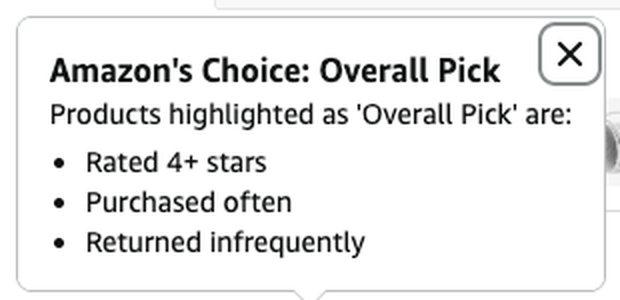
Three criteria: rated 4+ stars, purchased often, returned infrequently.
Two things to hold on to. First, this is Amazon’s own interface text, which makes it better evidence than any agency blog — but it is not a documented eligibility rule, and Amazon can change it without announcing anything. Second, rating is one of three, and the other two are sales velocity and returns. Getting to 4.0 does not buy you the badge. Sitting below 4.0 appears to rule it out.
Note also that the badge was largely rebranded from “Amazon’s Choice” to “Overall Pick” around 2024, with variants such as “Popular Brand Pick”. The old name survives mostly in the tooltip heading, which is why searches for the old term return contradictory, dated advice.
What has no rating requirement at all
This half of the picture matters just as much, because it is where sellers spend effort for nothing.
- The Best Seller badge. Amazon’s help text says the ranking is based on sales. Ratings and reviews are not mentioned. The orange badge is sales rank, full stop — which is why you will occasionally see one on a product rated under three stars.
- Subscribe & Save. Amazon’s own eligibility list covers Brand Registry, a strong fulfilment history, an in-stock rate above 90%, pricing conduct and a buyable offer. No star rating appears anywhere in it.
- The Buy Box, or Featured Offer. Your product’s star rating is not a criterion. Seller performance is an input, which is the source of the confusion — and in 2026 Amazon removed the seller eligibility step for the Featured Offer altogether, rolling it out in the EU and UK from July.
- Advertising. There is no published minimum rating for Sponsored Products, Sponsored Brands or Sponsored Display. The only rating-related rule in Amazon’s creative policy runs the other way: video ads may not show customer reviews or star ratings, even Amazon’s own.
If a provider tells you that review removal will get your Best Seller badge back or make you eligible for Subscribe & Save, they are selling you something Amazon does not gate on ratings.
The two ceilings, which work the opposite way
Two programmes care about your review count rather than your rating, and both set a maximum rather than a minimum. They are worth knowing because they expire quietly.
- Amazon Vine takes existing products with fewer than 30 reviews on the detail page. Once you are past 30, that door is closed for that ASIN.
- Review Requests, a new Amazon Ads format announced on 29 September 2026 and opening in beta in late October, is eligible for products with fewer than 1,000 total ratings and reviews, and pauses automatically when a product reaches that number. US only for now, with other marketplaces described as planned.
The question we get asked, so let us answer it directly: no, removing reviews does not take you back under a ceiling. Amazon’s ratings count is not a counter you can wind backwards for eligibility purposes, and treating removals as a route into Vine would be a bad plan even if it worked. Removal is for reviews that break a published guideline. It is not inventory management.
What this means if you are sitting at 2.7
Put the two halves together and the picture is sharper than “a low rating is bad”.
Between about 3.0 and 4.0 you keep every promotional lever Amazon offers. You lose the Overall Pick badge, and you lose conversion — which is the real cost, and which we cover in your star rating isn’t where the sale is lost.
Below 3.0 the character of the problem changes. You are no longer only converting worse; you are shut out of coupons, deals and discounts at the same time. The tools you would normally reach for to buy your way out of a slump stop being available precisely because you are in one. That is the compounding bit, and it is why the gap between 2.9 and 3.1 matters more than the gap between 3.9 and 4.1.
Which makes the honest next step a narrow one. Look at what is actually holding the number down. If a meaningful share of it is reviews that break Amazon’s published guidelines — wrong product, pure delivery complaint, abuse, advertising, personal data — those are reportable, and getting them off moves you. If the number is held down by fifty people describing the same real defect, no removal programme fixes that, and you should not pay anyone who says it will.
Why these numbers are so hard to pin down
Worth being transparent about, because it explains why so much of what you read about this is wrong.
Amazon’s detailed eligibility pages sit behind the Seller Central login. They cannot be indexed, linked to usefully, or checked by anyone outside the account. What exists publicly is a mixture of marketing pages, help nodes that describe things in general terms, and forum answers from Amazon staff that contain the actual numbers but carry no dates beyond “7 months ago”.
So the ecosystem fills the gap. An agency quotes a figure, a second agency quotes the first, and within two years a number nobody can source reads as established fact. That is how “Lightning Deals need 4 stars” ended up in circulation while Amazon’s own staff were saying three.
Our rule on this page: if we could not trace it to Amazon, it is not here. Where a figure comes from an undated forum post, we say so. Where it is four years old, we say that too. If you are checking a number that matters to your business, check it against the eligibility page inside your own Seller Central — that is the only version that is current and that applies to your account.
Frequently asked questions
What is the minimum star rating to run a Lightning Deal?
Three stars with some review history, according to an Amazon staff post in the seller forums from around March 2026, plus a Product Quality Score of at least 55 and a seller feedback rating of 3.5 with at least five ratings a month. The widely repeated 4-star figure comes from agency blogs and contradicts Amazon’s own statement.
Can I run coupons with a bad rating?
Down to a point. Amazon staff state 2.5 stars for products with one to four reviews and 3.0 for products with five or more. Products with no reviews at all are eligible. Coupons are therefore the last promotional tool you lose on the way down.
Does a low rating stop my ads from running?
No. There is no published minimum rating for Sponsored Products, Sponsored Brands or Sponsored Display. Your ads keep running; they just convert worse, which is a budget problem rather than an eligibility one.
Will removing reviews get my Amazon’s Choice or Overall Pick badge back?
It can help if your rating is what is below the line, since the badge tooltip lists “rated 4+ stars” as one of three criteria. But the other two are how often the product sells and how often it is returned, and nobody can promise you a badge. Amazon publishes no formal eligibility rule for it at all.
Is the 3.5-star requirement about my product or my account?
Your account. It is the seller feedback rating, and it is a different number from your product’s star rating, with a different removal route and a shorter window. The two being confused is the most common misunderstanding in this whole area.
Do these thresholds differ between the US and Europe?
We found no Europe-specific rating thresholds — the same numbers appear in Amazon staff posts across the US, UK, Canadian, Indian and EU forums. Some programmes do differ by region: Review Requests is US-only for now, and Vine’s fee model is not the same in Europe as in the US.
Sources, and how solid each one is
- Overall Pick criteria — read off the badge’s own info tooltip on a live amazon.com search result on 28 October 2026. Screenshot above.
- Amazon Vine — the under-30-reviews ceiling, on Amazon’s own programme page (US).
- Review Requests — Amazon Ads announcement, 29 September 2026, with the under-1,000 ceiling. US only.
- Subscribe & Save eligibility — Amazon’s own criteria list, which contains no rating requirement.
- Amazon Ads creative acceptance policy — no rating-based eligibility bar anywhere in it.
- Coupons — the 2.5 and 3.0 thresholds, posted by an Amazon moderator (around 2023, still repeated by practitioners in 2026).
- Lightning Deals — 3 stars, Product Quality Score of 55, and the seller-side feedback requirement. Posted around March 2026, the most recent staff statement we found on deals.
- Price Discounts and Prime Exclusive Discounts — both 3 stars. The Prime Exclusive post is around four years old and is the only Amazon-authored source we could find for it.
- Deals, EU forum — the 3.5-star requirement stated as a seller rating.
- Best Sellers Rank — Amazon help text stating the ranking is based on sales.
What we left out. Several widely repeated figures — a 4-star minimum for Lightning Deals, a 3.5-star or 4.7-star requirement for Subscribe & Save, a 10–15% return rate as the trigger for the “frequently returned” label — trace back only to agency blogs, contradict Amazon’s own statements, or cite no source at all. They are not on this page.

Cueneyt has spent years inside Amazon seller accounts — first in account management at SellerVate, with more than 10,000 solved account cases, now in review removal with 5,000+ reviews taken down. These guides come out of what actually happens in those cases.
About Starfix.ai: Starfix.ai is a success-based Amazon review removal service. It reports only reviews that break Amazon’s Community Guidelines, through Amazon’s official channels, and charges only for reviews that are actually removed. Whether a review comes down is Amazon’s decision in each case.
Sitting below one of these lines?
Paste your ASIN into the free review checker. We come back with how many of the reviews holding that number down break an Amazon guideline — and you pay only for the ones that actually come off.